

The true test of any financial innovation is how it performs in a storm. For 0-DTE options, that storm arrived in April 2025, when a sudden wave of tariff escalations and geopolitical shocks triggered a full-blown market panic. As volatility surged and the S&P 500 fell sharply, 0-DTE options found themselves at the center of the action—not just as a trading vehicle, but as a force potentially influencing market dynamics in real time.
This episode offered a rare window into the behavior of zero-day options under extreme stress. It revealed both their power and their limitations—how they can amplify short-term moves, shift trader behavior, and respond with surprising resilience once the dust begins to settle.
Amplifying Intraday Swings
One of the most visible effects of 0-DTE options during April’s turmoil was their role in magnifying intraday volatility. The mechanism behind this lies in the hedging behavior of market makers. As traders aggressively bought ultra-short-term puts and calls—particularly to hedge against the accelerating selloff—dealers who sold these options were forced to dynamically adjust their exposure in real time.
In a falling market, dealers holding short puts found themselves in a “short gamma” position. To remain delta-neutral, they had to sell S&P 500 futures or underlying stocks as the market declined, effectively adding to the downward pressure. On sharp rebounds, the same hedging process required them to buy aggressively, contributing to violent intraday reversals. This was clearly observed on April 9, when the S&P 500 staged a historic one-day rebound, driven in part by these amplified flows.
This feedback loop—often referred to as the “gamma trap”—can transform an otherwise contained move into a rapid cascade. With 0-DTE volumes at elevated levels, these flows were large enough to impact market liquidity and direction on a minute-to-minute basis. In effect, these structural dynamics render the market highly reactive, adjusting almost instantaneously to shifts in sentiment or news.
VIX Underselling Risk: A Term Structure Disconnect
Interestingly, despite the severity of intraday moves in early April, the VIX—designed to measure 30-day implied volatility—failed to reflect the true intensity of those swings. As traders rushed into 0-DTE options to hedge or speculate on immediate price action, short-dated implied volatility spiked sharply, diverging from longer-dated measures.
This divergence created a pronounced inversion in the volatility term structure: implied vol for 1-day expirations surged well above longer-dated options, as shown on the chart below. In effect, the traditional VIX was “underselling” the magnitude of short-term risk, even as the market moved hundreds of points within hours.
This breakdown in the volatility curve highlights a growing structural feature of modern markets. With the rise of 0-DTE trading, volatility demand has become increasingly front-loaded—making short-term premiums more sensitive to flows, positioning, and event risk. In April’s case, that meant the most intense pressure was concentrated in the near-term, while the broader curve remained comparatively anchored.
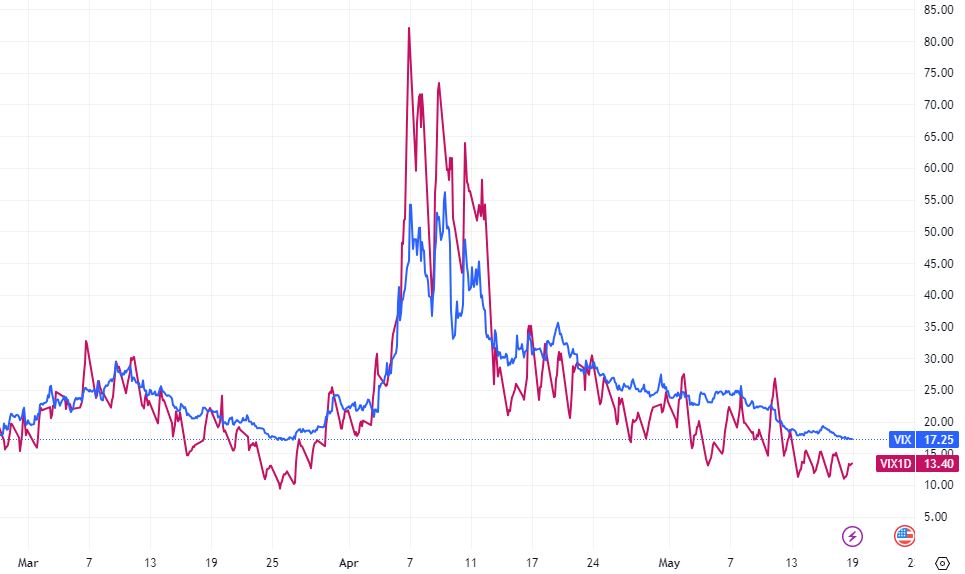
VIX Index vs. VIX 1Day Index
Record Volumes and Behavioral Shifts
The April turmoil pushed options activity to new highs. February and March 2025 had already set volume records, but April surpassed them—culminating in massive spikes on April 4 and April 9, when SPX option volume reached 6.1 million and 4.8 million contracts, respectively, with notional values approaching $3.1 trillion per day.
Yet at the peak of fear earlier in the month, trader behavior had shifted. According to Goldman Sachs, 0-DTE volumes dipped meaningfully during the most volatile sessions as participants moved toward slightly longer-dated protection. When the market was in free-fall and the VIX spiked, many opted for options expiring several days or weeks out, favoring more durable hedges over the hypersensitivity of same-day contracts.
Retail traders, who typically represent a majority of 0-DTE flow, also pulled back temporarily. Cboe data shows that retail’s share of SPX 0-DTE volume dropped from around 57% to 47% during the height of the panic. Even the most risk-seeking participants stepped aside as volatility approached historic extremes. However, the 0-DTE engine didn’t stall—it briefly downshifted. And once the market began to stabilize, activity returned at full speed, fueled by renewed volatility premiums and tactical trading opportunities.
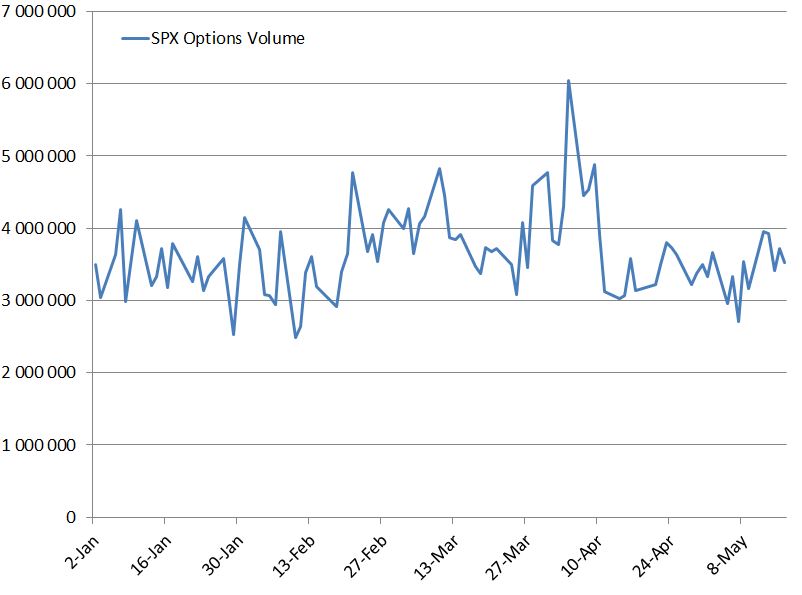
SPX Options Volume, Contracts
Resilience and Quick Rebound
Importantly, the 0-DTE market proved highly resilient once the initial shock subsided. As volatility retreated from its early-April extremes—settling into a VIX range of 25–30—retail traders quickly re-engaged. Within weeks, their share of SPX 0-DTE volume rebounded to approximately 60%, and total volumes returned to record levels.
This behavior aligns with a now-familiar pattern: during volatility spikes, participation temporarily fades, but resumes just as quickly once conditions stabilize. Richer premiums, tighter bid/ask spreads, and the reemergence of tradable intraday patterns tend to pull both retail and institutional traders back into short-term strategies.
By late April 2025, the popularity of zero-day options was not only intact—it had likely expanded. The intense media attention surrounding the April selloff introduced a broader audience to 0-DTE trading, reinforcing its status as a central feature of modern market structure.
Conclusion: A Spotlight on 0-DTE
During the April 2025 volatility event, 0-DTE SPX options proved to be a double-edged sword. They offered traders unique opportunities to hedge or profit amid the chaos—a well-timed 0-DTE put on April 4 or call on April 9, for instance, could have delivered exceptional returns. At the same time, they likely amplified the speed and magnitude of market swings, requiring heightened caution and disciplined risk management.
Crucially, 0-DTE options were not the root cause of the sell-off. The primary catalyst was fundamental: a series of unexpected tariff announcements that disrupted global markets and triggered widespread repricing. Zero-day options acted as an accelerant, not the ignition source. And despite concerns about their destabilizing potential, no major tail-risk events materialized. According to Cboe, more than 95% of SPX 0-DTE trades during this period were executed using limited-risk strategies—such as defined-risk spreads or outright long positions. This structured approach helped contain systemic risk and highlighted the growing maturity of the 0-DTE ecosystem.
As conditions stabilized, the 0-DTE game resumed in full force. By late April, zero-day options had not only regained momentum—they had clearly emerged as a defining feature of modern market structure. What was once a fast-growing niche is now one of the most prominent segments in the options landscape. For observers on the sidelines, the April turmoil put a spotlight on zero-day options like never before, with mainstream financial media debating their merits and dangers as the new “it” thing on Wall Street.